Previous Harness
Layered roles
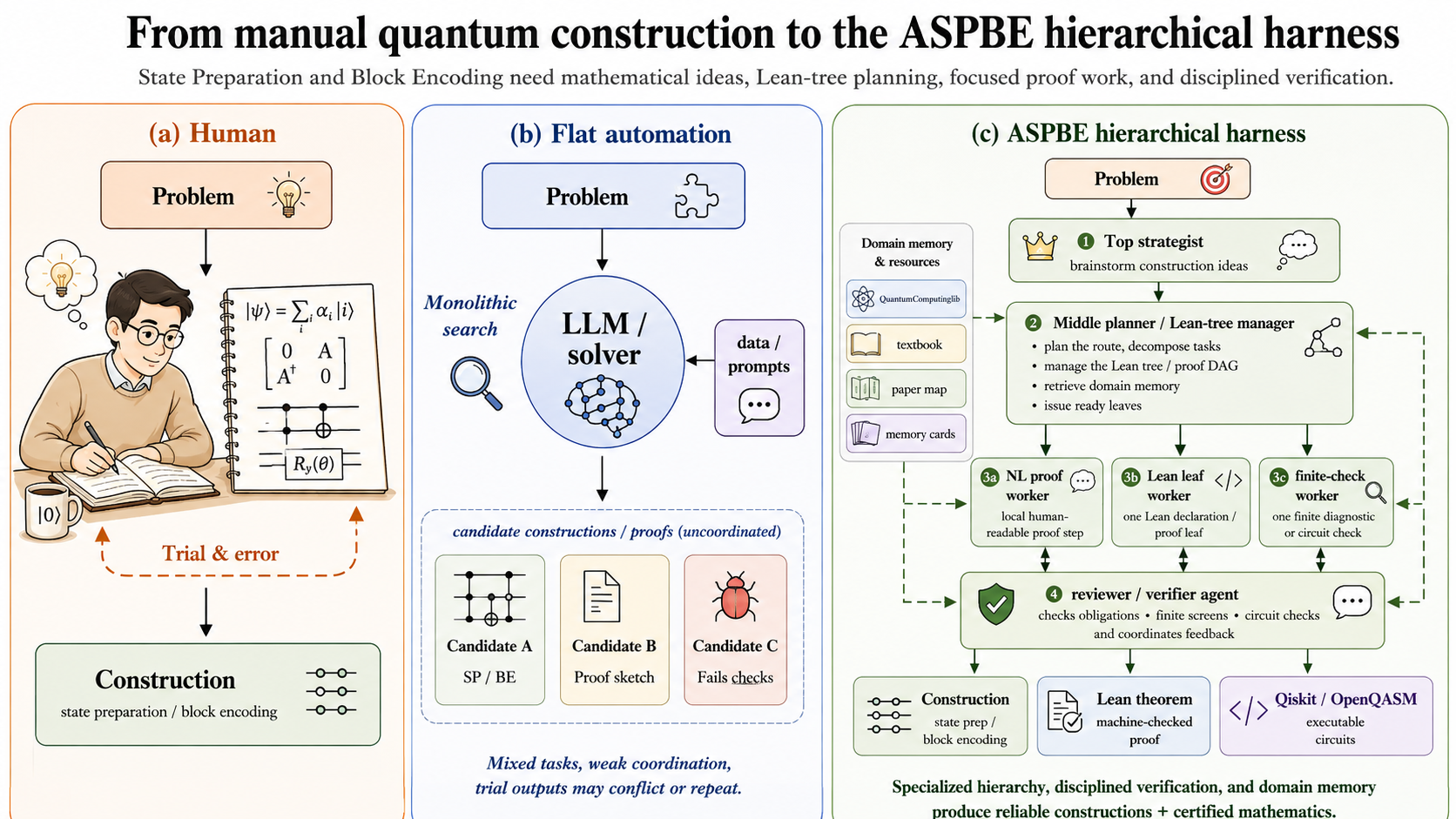
Upper strategist → Middle Lean-tree manager → focused workers → reviewer.
ASPBE harness
Both generations keep a frozen mathematical contract and hard verification. The previous Harness routed work through fixed strategist / Lean-tree / worker / reviewer layers; the current Harness keeps the proof DAG but lets generalist Workers own substantive frontier advances end to end under a Frontier Master.
Previous → current
The old hierarchy made handoffs explicit. The current system keeps the hard gates and durable theorem graph, but parallel Workers may cross source, math, Lean, diagnostics, and exposition whenever that moves the root theorem.
Previous Harness
Upper strategist → Middle Lean-tree manager → focused workers → reviewer.
Current Harness
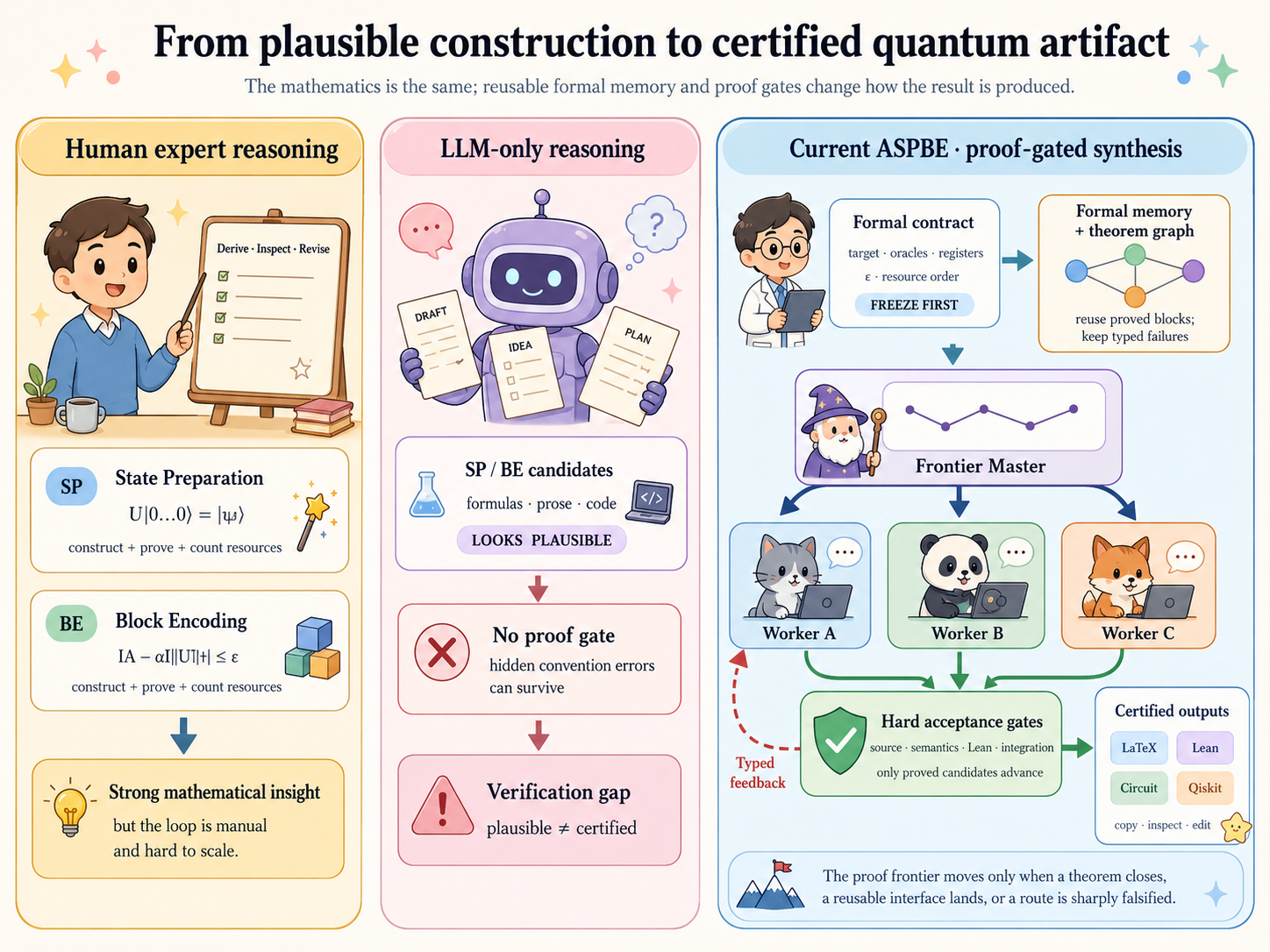
Frontier Master → parallel generalist Workers → hard proof gates → certified outputs.
flowchart LR
  subgraph OLD["Previous layered Harness"]
    direction TB
    O0["Frozen task contract"]
    O1["Upper strategist<br/>choose objective · allocate budget"]
    O2["Middle Lean-tree manager<br/>decompose proof DAG · route feedback"]
    O3["Lower focused workers ×N<br/>solve bounded source / math / Lean leaves"]
    O4["Reviewer / verifier<br/>source · semantics · Lean · resources"]
    O5["Accepted theorem or typed failure"]
    O0 --> O1 --> O2 --> O3 --> O4 --> O5
    O4 -- "diagnostic feedback" --> O2
  end

  subgraph NEW["Current Frontier Master + Generalist Workers"]
    direction TB
    N0["Frozen State Preparation / Block Encoding contract"]
    N1["Frontier Master<br/>maintain global theorem graph · select real bottlenecks"]
    N2["Generalist Workers ×N<br/>own substantive objectives end to end<br/>source ↔ math ↔ Lean ↔ diagnostics ↔ exposition"]
    N3["Local integration<br/>compare evidence · preserve cross-layer ideas"]
    N4["Hard acceptance gates<br/>source fidelity · circuit semantics · Lean · integration · readable proof"]
    N5["Certified frontier advance<br/>or sharp typed obstruction"]
    N6["Researcher-facing outputs<br/>LaTeX proof · Lean · circuit · Qiskit/OpenQASM"]
    N0 --> N1 --> N2 --> N3 --> N4 --> N5 --> N6
    N5 -- "update theorem graph" --> N1
  end

  O4 -. "hard verification retained" .-> N4
  O2 -. "proof-DAG memory retained" .-> N1
  O3 -. "fixed role walls removed" .-> N2

  classDef old fill:#fff3d9,stroke:#b78638,color:#4b3517,stroke-width:1.5px;
  classDef oldGate fill:#ffe6d8,stroke:#b85d3b,color:#5a2c1c,stroke-width:1.6px;
  classDef master fill:#e8f3ff,stroke:#4778a6,color:#19364e,stroke-width:1.7px;
  classDef worker fill:#f0eaff,stroke:#7960a5,color:#30244a,stroke-width:1.5px;
  classDef gate fill:#e3f6ea,stroke:#3b805a,color:#173b29,stroke-width:1.7px;
  class O0,O1,O2,O3,O5 old;
  class O4 oldGate;
  class N0,N1,N3,N6 master;
  class N2 worker;
  class N4,N5 gate;
Translate the mathematical request into a state-preparation or block-projection contract.
Retrieve compatible completed declarations, route cards, and known obstructions.
Generate distinct constructions and retain provenance, assumptions, and resource tuples.
Apply the declared lexicographic score without promoting an invalid candidate.
Split unitarity, dimensions, register order, projection, normalization, and approximation goals.
The upper layer may add agents, recombine routes, or relax epsilon only from recorded feedback.
Require the Lean build, tests, no-new-proof-hole policy, and source-linked documentation.
Run applicable circuit or matrix exports, including Qiskit checks, after the formal certificate gate.